Voice & character intelligence
USAW
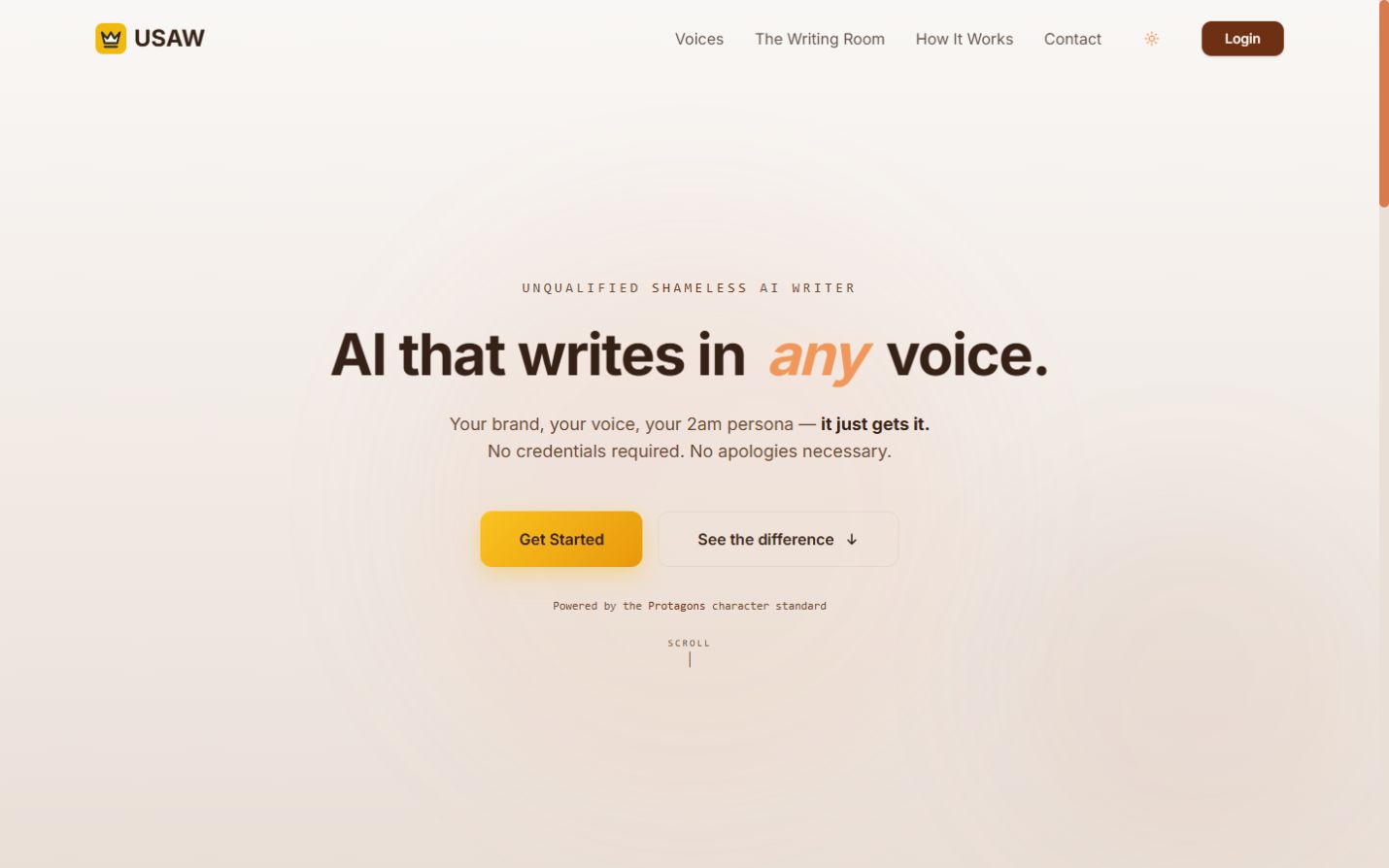
A voice system — not another blank AI text box.
- Role
- Product, design & engineering
- Type
- Live SaaS product
- Timeline
- 2024 – present
- Live at
- usaw.ai
Part of a system
Extract USAW pulls the character out of how someone actually writes. The schema underneath is open and portable — that’s Protagons — and with the behavioural and decision layers switched on, the same file becomes a buyer you can rehearse against in Sales Practice.
The friction
“Your LinkedIn doesn’t sound like your email” is the wrong complaint — they’re supposed to sound different. The real problem sits upstream: nobody has mapped the content matrix, so no one can say which audience gets what at which stage, let alone what register each of those cells should be written in. Without that map, range becomes drift — every writer, agency, and AI tool improvises its own read of “our voice.” And underneath it there’s no character to flex: generic AI writes from nowhere, with no identity and nothing to stay consistent to.
Where AI helps
Character first, then calibration. Voice is a pattern problem at a scale you can’t hand-code, so USAW runs 28 analysis agents in parallel to decompose real writing into a structured identity — not just tone, but how you hedge, how you handle a counter-argument, your emotional range, what you actually believe. Everything generates from that identity, then flexes per cell of the matrix. AI is the right tool because it can both extract the character and hold it steady while the register changes.
Who it helps — Brands, marketing and content teams, agencies, and solo creators who need everything they publish to sound like them — plus AI builders who want a consistent character across models, which is what the open schema underneath is for.
What I built
-
Voice Architecture
Samples or a description become a structured, editable identity — 28 dimensions running from rhetoric and cadence through psychology to worldview. Every trait is visible, evidence-backed, and tunable, so the voice is a document you can argue with rather than a vibe.
-
The Content Map
A dual 2×2 per audience: prospect and client lifecycles crossed with Entertain, Inspire, Educate, Convince. It files what you’ve already written into cells, shows you the empty ones, and gives each cell its own assigned calibration of the same voice.
-
A five-layer generation stack
Style → Brief → Format → Standards → Policies, kept deliberately narrow. A fast rules pass catches the objective breaks, then a model pass judges the subjective ones — so a draft changes register per channel without changing character.
Proof